Are you the person friends come to when they want their hair doing before going out? Does a new make-up technique send you down a two-hour rabbit hole?
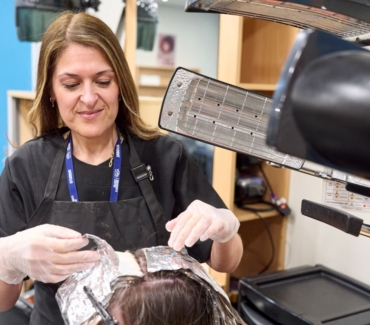
Turning that into a career takes proper training, and our Hair & Beauty Courses give you just that. You will work across hairdressing, barbering, beauty therapy and media make-up in professional salon conditions, learning treatments and services on real people rather than reading about them.
Level 1 if you are starting from scratch, Level 2 and Level 3 as you specialise, apprenticeships if you would rather earn while you train, and degree-level study at our University Centre if you want to take it further.
Work in Salons, Treatment Rooms and Make-up Studios
Four commercial beauty therapy treatment rooms, three professional media make-up studios and two large hairdressing salons make up the department, alongside a fully functioning reception and shop. Our Inspired Salons run as a commercial operation, so you learn the front-of-house side of the job as well as the treatment itself.
Everything you use is professional standard, from the products on the shelf to the equipment at each station. That matters more than it might sound, because the first thing an employer will ask is what you have actually handled.
Hairdressing and Beauty: Practice on Each Other, Then Work With Real Clients
Training starts with your own group. You model for each other while you practise, which means you experience treatments from the client's side as well as the therapist's, and you build up a feel for how something should look and feel when it is done properly. Once you are ready, you move on to College clients under staff supervision. Working with someone who has booked an appointment and expects a result is a different kind of pressure to practising on a classmate, and it is where confidence really develops. By the time you finish you will have consulted, delivered and adapted treatments for people you have never met before.
Assessment reflects that. Practical observations on paying clients sit at the centre of your grade, backed by oral and written questioning, assignments and projects.
Learn From Tutors Who Have Worked in the Hair and Beauty Industry
Every tutor in the department is a qualified Beauty Therapist, Hairdresser, Barber or Make-up Artist. They keep up with new treatments and developments as they emerge, and they hold strong links with employers and industry experts across the region.
See Where Our Students End Up
Media Make-up student Abi Horton won a global award for her first job in film, and she is not the only one. Former students of the same tutors have gone on to work on productions recognised at the Oscars, the Emmys and the BAFTAs. Others take a completely different path in. Nicole Cooper came to us to qualify as a hairdresser after illness ended a 17-year teaching career, which is worth knowing if you are considering a change later on.
Progression from here runs in several directions. Salon and spa employment, self-employment, an apprenticeship in hairdressing, barbering or beauty therapy, higher-level aesthetics qualifications, or the Foundation Degree in Media Make-up, Special Effects & Hair Design with a BA (Hons) top-up after it.
Vocational & T Level
University Centre
Apprenticeship
Courses for Adults
Vocational & T Level
University Centre
Apprenticeship
Courses for Adults


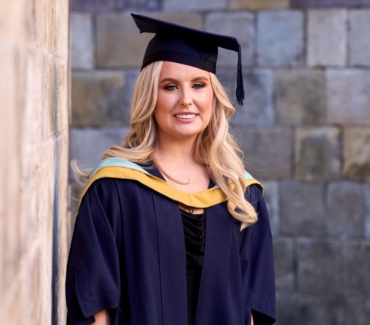
I did my Level 3 at College and the tutors played a big part in me wanting to stay on for the degree. Being taught by people who have experience in the industry at places you aspire to work at is amazing. Seeing people winning Oscars, Emmys and BAFTAs, who have been on the same course with the same tutors, also gives you a realisation that it’s actually possible.
Which qualification should you start with?
That depends on your grades and your experience. Beauty Therapy & Media Make-up City & Guilds Level 1 and Introduction to Hairdressing & Barbering NVQ Certificate Level 1 are the entry points, both asking for a minimum of three GCSE subjects at grade 2. With stronger grades or a Level 1 qualification behind you, you can go straight into a Level 2 programme.
What is the difference between hairdressing, beauty therapy and media make-up?
Hairdressing and barbering cover cutting, colouring, styling and client consultation. Beauty therapy covers facials, waxing, manicure, pedicure, lash and brow treatments and make-up. Media make-up is the creative and theatrical side, taking in special effects, prosthetics and hair design for film, television and theatre. Our Theatrical, Special Effects & Hair & Media Make-up Certificate/Diploma Level 3 sits in that last category.
Do you need to buy anything before you start?
Yes. All students purchase a practical kit and a uniform, and there is a salon dress code to follow. Details of both come through at your advice and guidance discussion and again at induction, so you will know what is needed well before your first session.
Can you combine a hair or beauty course with A Levels?
No. These are full-time programmes, so they cannot be taken alongside A Levels, T Levels, apprenticeships or other vocational courses. If you want to train while working instead, an apprenticeship is the option to look at.
What personal qualities suit this industry?
Creativity paired with a caring nature. You are working closely with people who want to look and feel better, so good communication matters as much as technical ability, and the course puts real emphasis on developing it. A genuine interest in receiving treatments as well as giving them helps too, given how much of your training happens in pairs.
Will you compete or take part in anything beyond lessons?
Yes. Competition work runs through the programmes as a way of showcasing technique, and enrichment activities are scheduled across the year to extend your skills. These also give you something concrete to talk about at interview.
How far can you take these qualifications at York College?
All the way to degree level without leaving campus. Beyond Level 3 you can move into Level 4 and Level 5 aesthetics qualifications covering areas such as skin needling, skin peeling, micropigmentation and radio frequency treatments, or take the Foundation Degree in Media Make-up, Special Effects & Hair Design and top it up to a full BA (Hons).