

A Levels vs T Levels vs Vocational vs Apprenticeships - Which Path Is Right for You?
Are you in Year 11 and starting to picture life after your GCSEs? It is one of the first big decisions you get to make about your own future, and with A Levels, T Levels, Vocational courses and Apprenticeships all on the table, it makes sense to know exactly how they differ before you choose.
They might all sit at Level 3 and all earn respect from universities and employers, but the way you learn on each one is very different. One keeps you in the classroom, one sends you out on an industry placement, one is more practical based and one puts you straight into a paid job. Getting to grips with that difference is the key to picking the route that suits you best.
At York College & University Centre, you have plenty to choose from, with around 40 A Levels, more than 80 Vocational and T Level courses and over 30 Apprenticeships, so whichever way you lean, we have a course to match.
What happens after your GCSEs
Once you leave school, most study at this stage sits at Level 3, which is the level above your GCSEs. The four main routes are A Levels, T Levels, Vocational courses and Apprenticeships, and the simplest way to tell them apart is the balance between classroom and workplace.
A Levels are almost entirely classroom based, while Vocational courses have a more practical focus. With T Levels, you split your time between the classroom and an industry placement. Apprenticeships flip that balance, so you spend most of your time in paid employment with training built around the job. You can see our full post-16 offering on our School Leavers pages, and there are answers to plenty of common queries on our School Leavers FAQs page. Let us look at each route in detail.
How A Levels work
A Levels are academic qualifications studied over two years, and most learners take three subjects at once. Assessment is mainly through written exams sat at the end of the two years, so this route is ideal if you enjoy reading, building an argument and revising.
Every grade converts into UCAS points, which many universities use to make offers. Under the current tariff, an A* is worth 56 points, an A is 48, a B is 40 and a C is 32, so three strong grades give you a competitive total. You can work out any combination on the official UCAS Tariff points calculator.
If you’re aiming for a competitive university, the subjects you pick matter as much as the grades, because facilitating subjects such as Maths, the Sciences, English, History, Geography and Languages keep the widest range of degrees open to you. For 16 to 18-year-olds, there are no course fees, and A Levels remain the most common route into Higher Education. Explore the full list on our A Levels & Mix pages.


How T Levels work
T Levels were introduced by the government in 2020, and each one is broadly equivalent to three A Levels. They bring together a technical qualification, made up of core knowledge and an occupational specialism, and an industry placement of at least 315 hours, which works out at roughly 45 days with an employer. Across the two years, you can expect around 1,100 to 1,300 classroom hours, which equates to about 20% of the course spent on placement and 80% in the classroom.
The placement is what sets T Levels apart from other course types. It lets you apply your learning in a genuine workplace, build professional contacts and leave with real experience on your CV, which is exactly the sort of head start we talk about in our blog on why you might want to consider a T Level. Assessment is broader than A Levels too, using exams, employer-set projects and the placement rather than exams alone. T Levels are graded pass, merit, distinction, or distinction*. A distinction* is worth 168 UCAS points, the same as three A*s at A Level. You can read the official overview in the government's Introduction of T Levels guidance.
Because T Levels are built on the same employer-designed standards as Apprenticeships, they carry real weight with universities and businesses alike. Progression is strong: in the 2024 admissions cycle, 83% of T Level applicants who applied to Higher Education secured a place. Our own offering keeps growing, with new courses in Marketing, Craft & Design and Legal Services added to the range. See the full picture on our Vocational & T Level pages.


How Vocational courses work
A Vocational course focuses on practical, hands-on learning designed to prepare you for a specific career or industry. At York College, our Vocational courses combine coursework-based study with real-world skills, helping you build the knowledge and experience needed for employment, Apprenticeships or further study. We offer courses across a wide range of professional, technical and creative subject areas. This year, we celebrated increases in high grades for our Vocational courses.
If you enjoy learning in a practical way and developing skills you can use in the workplace, a Vocational course could be the right choice for you.
Whether you’re starting at Entry Level or progressing to Level 3, you’ll find a course that matches your interests and career goals


How Apprenticeships work
An Apprenticeship is a real, paid job with training built in, so you earn a wage while you work towards a nationally recognised qualification. You need to be employed for a minimum of 30 hours a week, with at least 20% of your time, around six hours a week, set aside for off-the-job training that takes place both in your workplace and at College. We also offer block weeks of study in College for some of our Apprenticeships, depending on what suits you and your employer.
Because you’re employed, you are treated as a proper member of staff, with paid holiday and the same rights as your colleagues. There are no course fees to you either, because Apprenticeship training is funded by the government and your employer, whatever your age. The apprentice rate of the National Minimum Wage is currently at least £8 an hour, and many employers choose to pay more, then once you turn 19 and complete your first year, you move on to the full minimum wage for your age. You can check the latest figures on the government's Become an apprentice pages, and there is more on the real benefits of choosing to earn while you learn in our blog on why you might consider an Apprenticeship.
Apprenticeships run from Level 2 all the way up to degree level, so they are far from a single starting point, and there is one more change worth knowing about: from September 2026, Apprenticeships will begin to carry UCAS tariff points too. The one thing to remember is that you need to secure an employer before you can begin, so it’s worth keeping an eye on our current Apprenticeship vacancies as you plan. Learn more on our Apprenticeships pages.

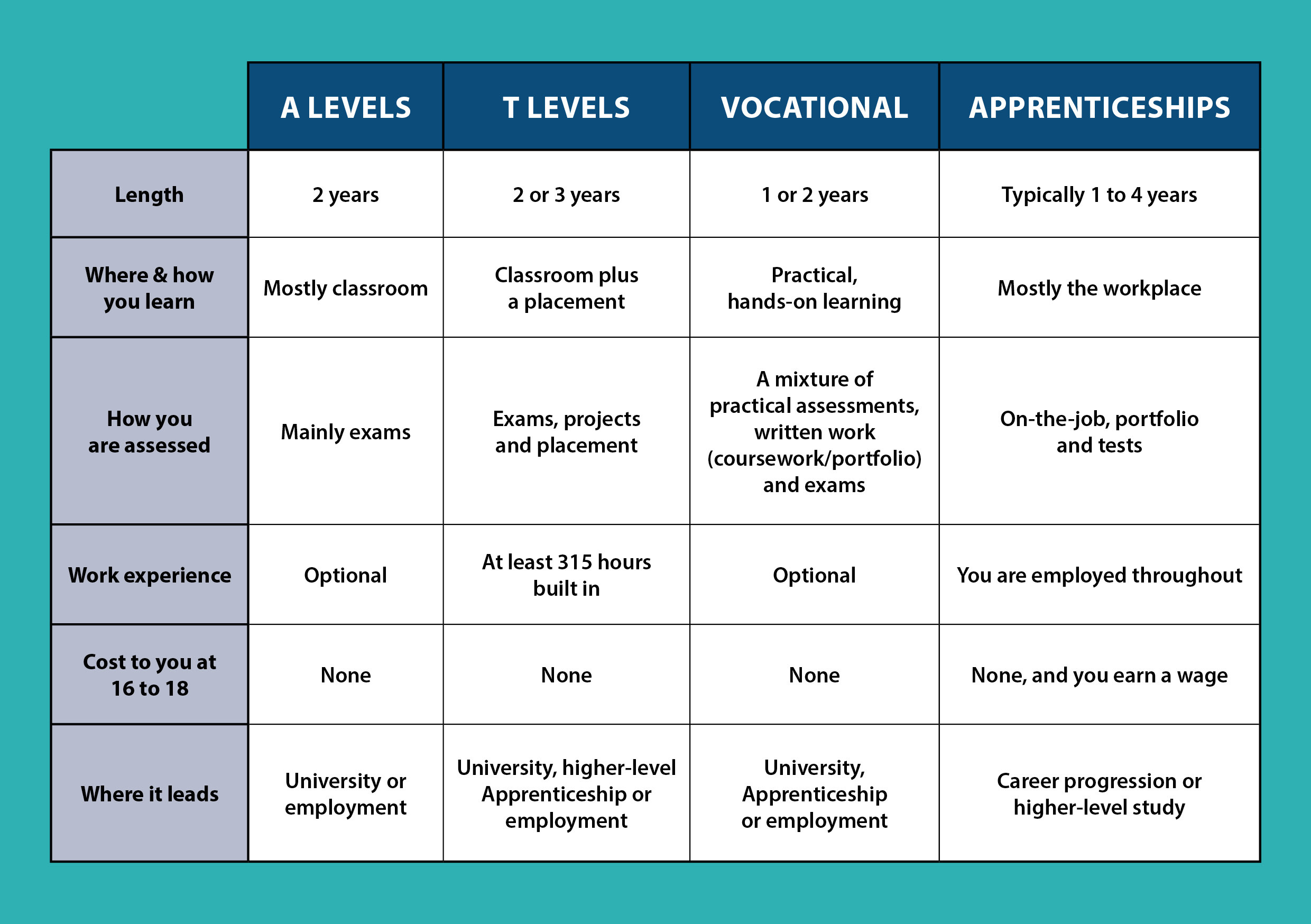
How A Levels, T Levels, Vocational courses and Apprenticeships differ
Can you combine academic and technical study?
Yes. At York College, it’s possible to combine two A Levels alongside one more practical-based course, such as an Alternative Academic Qualification, known as an AAQ, These are practical, employer-endorsed courses that carry the same UCAS points as an A Level, and they are backed by more than 100 universities, as we explain in our blog on how York College Mix lets you combine A Levels with a Vocational subject.
It is a genuinely flexible option if you love academic study but also want deeper, career-focused knowledge in an area such as Applied Science, Engineering, Health, or Sport, Exercise & Health. Find out how it works on our York College Mix pages.
How to decide which route suits you best
Start with how you learn best. If you thrive on written work, discussion and exams, A Levels are a natural fit, where as if you prefer practical work, a Vocational course could work well for you If you want to keep studying but crave real workplace experience, a T Level gives you both. Meanwhile, if you are ready to earn, take on responsibility and learn on the job, an Apprenticeship could be the right fit.
Then think a step ahead about where each route could take you, whether that is university, a degree Apprenticeship or a skilled role straight away. It is reassuring to know that all four lead to strong destinations.
A few practical questions are worth considering. Are you happy sitting exams, or do you prefer coursework and hands-on assessment? Do you want to keep several career options open, or do you already know your field? Are you ready to commit to a working week? And do you meet the entry requirements for the level you want? You can check these on our Entry Requirement Information page. If you’re still unsure, that is completely fine, because our Progress Coaches and Careers Team are here to help you weigh it all up. It’s also possible to start on a lower-level course before progressing to Level 3 if needed.
Ready to take your next step with us?
Whichever path feels right, the best way to be sure is to come and see us at one of our open events. Meet our tutors, explore our facilities and ask your questions in person at an Open Event, browse everything on offer across our Curriculum Areas, then start your application when you feel ready. We’re here to help you choose your next step with confidence.


Frequently Asked Questions about A Levels, T Levels, Vocational courses and Apprenticeships
Entry requirements vary by route and course. As a general guide, A Levels usually ask for a minimum of four GCSEs at grade 5 or above, plus English Language and Maths at grade 4 or above. Vocational courses, T Levels and Apprenticeships have different entry requirements depending on the level you are applying for. Always check the individual course page and our Entry Requirement Information for the exact grades you need, or talk to us about your individual circumstances at one of our Open Events.
All four routes can lead to university. A T Level Distinction* is worth 168 UCAS points, the same as three A*s at A Level. A Levels are awarded UCAS points individually, and from September 2026, Apprenticeships will also carry UCAS tariff points. The most important thing is meeting the entry requirements for your chosen university course, so always check these directly.
The amount of classroom time depends on the route you choose. A Levels are almost entirely classroom based. On a T Level, around 80% of your time is spent studying. Apprentices spend most of the week in paid employment, while completing at least 20% off-the-job training.
If you are aged 16 to 18, there are no course fees for A Levels, T Levels, Vocational courses or Apprenticeships. Apprenticeship training is funded by the government and your employer regardless of age, and you will also earn a wage of at least £8 per hour as an apprentice, although many employers pay more.
Vocational and T Level courses are full-time programmes with a similar workload to studying three A Levels, so they are not normally combined with A Levels. From September 2026, York College Mix allows you to study two A Levels alongside one more practical-based course.
Changing your mind is more common than you might think, and there is support available. Before enrolment, you can speak with our Admissions Team about changing your application. Once you join us, our Progress Coaches and Careers & Enterprise Team will help you find the route that best suits your goals and interests.