How to Choose the Right College Course After GCSEs
Year 11 goes quickly, with lots of things to do – like attending Open Events – and you are asked to make decisions on your next two years almost as soon as you’ve got back to school in the autumn term. Friends are all applying somewhere different, everyone at home has a view and the deadlines seem to creep forward every year.
Most students have more than one option that would genuinely work for them. With around 40 A Levels & Mix courses, 80 Vocational and T Level courses and a range of Apprenticeships here at York College, the difficult part is usually narrowing things down rather than finding something in the first place.
Start With What You Actually Enjoy
It’s tempting to pick subjects because they sound impressive, because a particular career pays well or because your friends are choosing them. Those reasons tend to wear thin somewhere around the second term.
You’ll spend at least two years studying these subjects. You’ll read about them on wet Tuesday mornings, revise them at half term and talk about them in interviews. Genuine interest is a major factor here. It’s what carries you through the harder weeks, and it usually shows up in your grades too.
Look back at the last two years of school. Which lessons did you enjoy turning up to? Which homework did you leave until last because you dreaded it, and which did you do first? If you’re drawn to a subject you’ve never studied before, take that seriously as well. Plenty of students discover Carpentry & joinery, Criminology, Esports or Travel & Tourism at College and never look back.
Struggling to figure out what you enjoy? The National Careers Service skills assessment asks about what motivates you and suggests careers to compare. It’s free, takes about 15 minutes, and gives you something concrete to base your decision on.
Think About How You Like to Learn
Students skip this question more than any other, and it makes the biggest difference to how happy you are once you start.
Some people do their best work in exams. They revise well, they think clearly under pressure, and they like the clean line under a subject at the end of the year. Others find that exams never show what they can really do, but hand them a live brief, a workshop, a salon or a placement, and they come alive.
Be honest rather than aspirational. If coursework deadlines spread across two years suit your way of working better than three exam papers in June, that tells you something important. If you learn best by doing something rather than reading about it, an Apprenticeship or a hands-on Vocational course may serve you far better than the route that looks most traditional on paper.
The Routes Open to You After Year 11
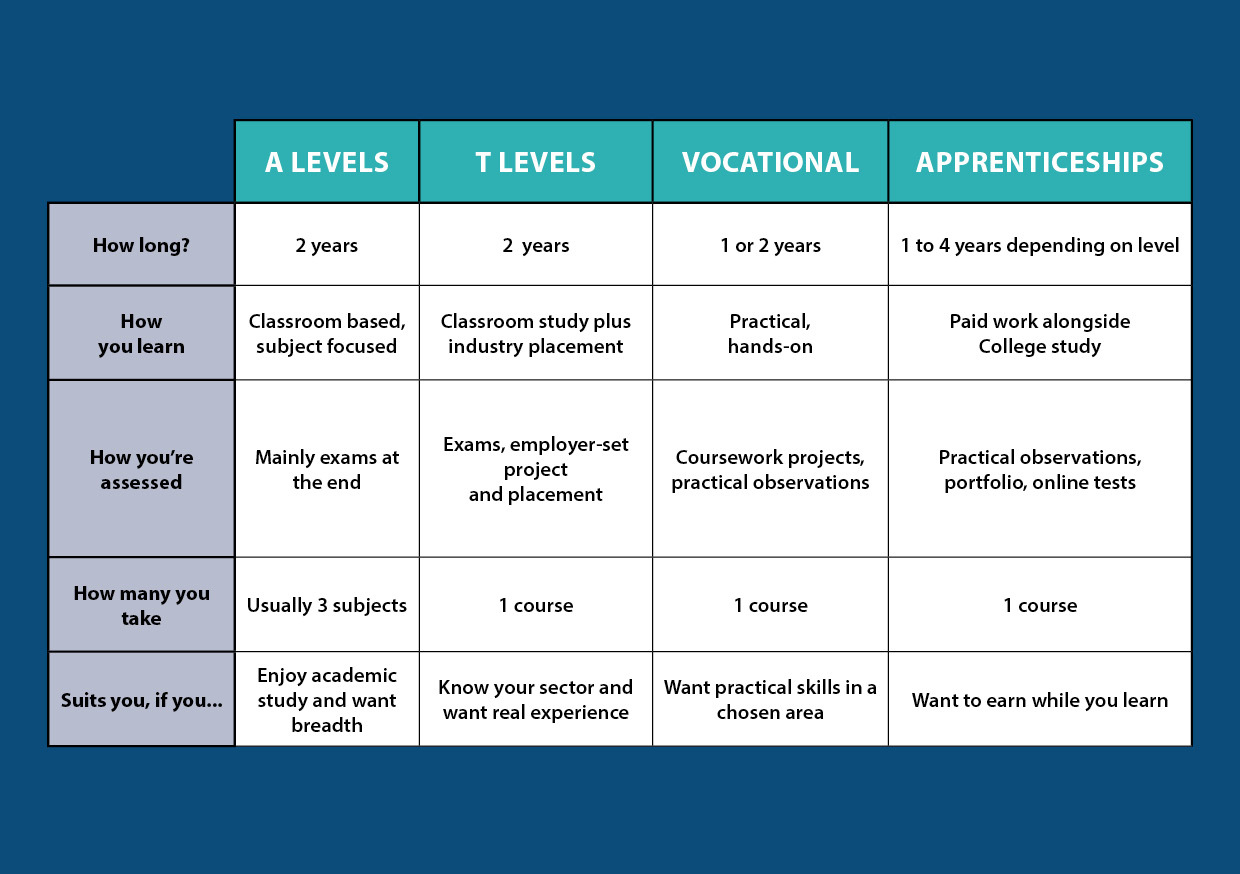
You must stay in education or training until you are 18, but that doesn’t mean staying at school. There are four main routes, mostly free if you’re aged 16 to 18:
A Levels
A Levels are studied over two years and are mainly assessed by exams at the end. Here at York College, they can be studied in practically any combination, which gives you room to keep your options open if you’re not yet certain where you’re heading. Don’t worry about odd-looking combinations either. The subjects that will give you your best grades matter more than a tidy-looking set.
You can also choose the York College Mix, which lets you combine two A Levels with one Vocational ‘Mix’ course. It’s designed for students who want the academic grounding of A Levels alongside something more practical, without committing fully to one style of learning.
Vocational Courses
Vocational courses take a more contextual approach. You’ll still cover theory, but you’ll apply it constantly through practical work, projects and assignments. These courses focus on one area, so they’ll suit you if you already know the field you’re interested in, whether that’s Health & Social Care, Motor Vehicle, Performance & Production or something else entirely. Our curriculum areas pages set out what each one covers. There are various levels of courses to choose from.
T Levels
T Levels are Level 3 qualifications developed with employers, and they include an industry placement of at least 315 hours, which works out at roughly 45 days. The placement is the point of difference. You’ll leave with a qualification and with real evidence of having worked in your sector, which matters when you apply for jobs, Higher Apprenticeships or degrees. The government's T Levels site explains how the grading works and which universities recognise them.
Apprenticeships
An Apprenticeship means being employed and paid while you train, with your learning split between the workplace and College. It’s a strong route if you’re motivated by real responsibility and want to start building a career straight away, though it requires you to be more independent than a full-time course does. Vacancies are advertised on our website, and you can also search nationally through Find an apprenticeship.


How Your GCSE Grades Shape Your Options
Your GCSE results affect which level you start at rather than whether you can study at all. Different levels carry different entry requirements, and some courses ask for particular subjects, especially where the content builds directly on GCSE work.
As a general guide, our entry requirements for A Levels are a minimum of 4 GCSE subjects at grade 5 or above, plus English Language and Maths at grade 4 or above. Vocational, T Level and Apprenticeship programmes have their own requirements, which you will find on our entry requirement information page and on individual course pages.
If you don’t achieve the grades you were hoping for, that’s not the end of a route; you can start at Level 1 or 2 and progress to Level 3 the following year(s), which many students do successfully. If you didn’t achieve a grade 4 in English or Maths, you’ll continue studying them alongside your main course, whichever route you take.
Apply before you have your results. Applications are made on predicted grades, and you can discuss your options again in August once you know where you stand.
Where Each Route Can Take You Next
A common worry is that choosing one route closes off the others. In practice, the paths overlap more than most people expect.
A Levels lead to University, Degree Apprenticeships and employment. Vocational courses and T Levels also carry UCAS points and progression routes into Higher Education, including our own University Centre, where you can study degree and higher-level qualifications without leaving York. Apprenticeships continue upwards through higher and degree level, so starting at Level 2 or 3 does not cap where you finish.
If a specific job is driving your decision, our Explore by Career tool maps careers against salary, predicted employment and labour market information, then links each one to the courses that lead there. Working backwards from a destination beats guessing which qualification an employer wants.
Questions Worth Asking Before You Apply
Once you’ve narrowed things down to two or three options, the detail starts to matter:
- How is the course assessed and does that suit how you work best?
- What does a typical week look like, including how much independent study you’re expected to do?
- What facilities will you actually use and how much time will you spend in them?
- Where did last year's students go afterwards?
- Are there kit, uniform or equipment costs?
- What happens if you start the course and find it’s not the right fit?
Ask that last one directly. Knowing there is room to change your mind early on takes some of the pressure off the decision.
What to Do If You’re Still Not Sure
Uncertainty at this stage is normal. Most people your age don’t have a fixed career plan and the ones who claim to often change their minds anyway.
Visit the College. Course descriptions can only tell you so much, and 20 minutes in a workshop, salon, studio or classroom will tell you more than an afternoon of reading. Our Open Events let you talk to the tutors who would actually teach you, ask about the parts of the course that worry you and see the facilities in use. Our guide on how to find the right course for you is worth reading beforehand so you arrive with sharper questions.
If practical concerns are on your mind, our funding and travel pages set out what support is available and how you would get here. Our Future Student Hub covers what the first few weeks actually look like.
Above all, talk to people. Your teachers, your careers adviser, your family and our own team have all had this conversation many times before. You don’t have to work it out alone.
Spend a Day Here Before You Decide
Our Year 11 Taster Days are the closest you’ll get to trying College before you commit. Current students are on study leave, so the place is given over to Year 11 for the day and you get a proper look at how it actually runs.
You pick the subjects you want to sample, sit in with the tutors who teach them and see the workshops, studios and classrooms in use rather than on a screen. You’ll also get a feel for the parts that don’t show up in a course description, like the support on offer and what people do between lessons. You get your timetable in advance so you know where you’re going and the College buses run as normal, which makes it a useful practice run for the journey.
We’re running two Taster Days: Tuesday 12 January 2027 and Thursday 14 January 2027, both from 8.45am to 4.15pm. Choose whichever date suits you, as you only need to attend one.
Places are allocated on a first-come, first-served basis and bookings close on Sunday 22 November 2026.
Come and See The College for Yourself
We would rather you chose your course having seen it than having read about it. Book a place at one of our Open Events to meet our tutors and explore our campus, or browse everything on offer through our courses pages. When you’re ready, our apply page walks you through each stage.
Frequently Asked Questions About Choosing a College Course
Apply during Year 11, ideally in the autumn or winter term before you sit your exams. You apply using predicted grades rather than final results, so there’s no need to wait until August. We’d encourage you to apply as soon as you know what you’d like to do – as some courses have limited places. Applying early means you can secure your place and sort out practical arrangements such as transport in good time.
Usually yes, provided you act quickly. Speak to your tutor or the Admissions Team as soon as you have doubts rather than waiting and they will talk through whether a move is possible. Any change depends on places being available and on you meeting the entry requirements for the course you want to move to.
You’ll still have options. You may be able to start on a Level 2 course and progress to Level 3 the following year, or move to a different course at the same level. Come to enrolment and talk to us. We will look at what you achieved and find a route that works. The National Careers Service also offers free advice on what to do after your results.
No. Plenty of students arrive without a fixed plan, and it doesn’t hold them back. If you’re undecided, A Levels keep the widest range of doors open because you study three subjects rather than committing to one field. Choosing a Vocational course or T Level in an area you enjoy doesn’t lock you in either, as the skills transfer more widely than people assume.
If you’re aged 16 to 18 and from England, there are no tuition fees. Some courses have uniform, kit or equipment costs, which are listed on the relevant course pages. Support with travel, meals and equipment is available depending on your circumstances, and you can find the details on our funding page. Apprenticeships are funded by the government and your employer, whatever your age.
At York College, the day runs from 9.15 am to 4.15 pm, and you may have gaps between lessons, which are yours to use for independent study in our learning areas. A Level lessons run for an hour, while Vocational and T Level lessons vary from one to three hours depending on the subject. You’ll be treated as a young adult and given more responsibility for managing your own time, alongside a full student support offer including learning support, wellbeing services and careers guidance.
Yes. T Levels and Level 3 Vocational courses both carry UCAS points and are accepted by Universities and Higher Apprenticeships lead to degree-level qualifications while you work. You can also progress to degree and higher-level study at our own University Centre. The route you choose at 16 shapes how you get there rather than whether you can.